
Modern Stadiums and Fan Experience: How Seating Affects Revenue, Comfort, and Branding
OMSI
STADIUM INSIGHTS
A strategic guide for clubs, facility managers and investors
omsi.it | Stadium Seating & Sport Facilities
2026
Introduction: the stadium as a strategic asset
For decades, stadiums have been perceived as sports infrastructure, a necessary but essentially passive space. A container. Today, that vision is radically outdated. The most advanced clubs, next-generation facility managers, and institutional investors view stadiums as strategic assets, capable of generating value well beyond the ninetieth minute. An asset that, if intelligently designed, transforms every spectator into a loyal customer, every match into a memorable experience, and every square meter into a profit center.
In this scenario, sports seating isn't a piece of furniture, nor a commodity purchased at the lowest price. It's the physical interface between the spectator and the facility, the first and most enduring point of contact with the club's brand, the factor that determines—more than any other variable—how long a person will sit, how comfortable they will feel, how much they'll spend during the evening, and whether they'll return next time.
This article analyzes the topic from the perspective it deserves: strategic, business-oriented, supported by data and real-world cases. The ideal audience is anyone involved in decisions regarding the architecture of the visitor experience—from club directors to facility managers, from real estate developers investing in new stadiums to the financial advisors evaluating these projects.
1. Evolution of stadiums: from infrastructure to experience
The transformation of modern stadiums has precise roots. Starting in the 1990s, the European and North American sports industries began to look beyond capacity and safety, introducing the concept of hospitality as a commercial lever. The first sky boxes, the first reserved VIP areas, and the first investments in premium grandstand furnishings paved a path that would become mainstream over the following decade.
The turning point came with the major construction projects of the 2000s: the Emirates Stadium (2006), the Allianz Arena (2005), and the renovated Wembley Stadium (2007). These facilities were designed not only to host matches, but to generate revenue every day of the week through corporate events, concerts, ceremonies, and tourist attractions. The multipurpose stadium was born here, and with it a new profession: that of the venue manager, who manages the facility like a five-star hotel, not like a sports arena.
"The modern stadium is a revenue ecosystem. The seating is the starting point of every economic flow it generates."
1.1 The digital revolution and the competition of the sofa
The spread of streaming has introduced a structural threat: the home couch has become a real competitor. High definition, the ability to watch instant replays, the comfort of home—all of this has raised the bar for the experience that the stadium must provide to justify the fans' physical presence. The match itself is no longer enough: we need a total, sensorial, social, and memorable experience.
The data confirms this: according to a 2023 Deloitte Sports Business Group study, 62% of spectators under 35 said they would return to the stadium more frequently if the physical experience were comparable—in terms of comfort and perceived quality—to that offered by premium home viewing. Seat comfort was cited as the primary deciding factor in 41% of cases.
1.2 The stadium as a brand experience
Top sports clubs have understood that the stadium is their flagship store. It's the physical space where the brand manifests itself in its most authentic and immersive form. Every element of the facility—from the colors of the stands to the architecture of the exits, from the design of the locker rooms to the seating—communicates the organization's values and builds a sense of belonging that no social media campaign can replicate.
In this context, investing in seating isn't a technical expense: it's a marketing investment. The seating is the first thing fans see when they approach the stadium from outside (thanks to the club's color scheme), it's the element that accompanies them throughout the event, and it's the last thing they touch before leaving. It is, literally, the longest and most repeated physical touchpoint in the entire club-fan relationship.
2. The role of sessions in public perception
The psychology of the stadium visitor experience is a relatively recent field of study, but already rich in evidence. Research on the topic converges on one point: the perceived quality of the seating directly and measurably influences the overall evaluation of the event. Not marginally, but decisively.
2.1 Comfort as an economic variable
An uncomfortable spectator—sitting in an uncomfortable chair, with limited legroom, exposed to unpleasant vibrations or noises—develops a disrupted cognitive focus. Part of their mental energy is devoted to managing physical discomfort. This reduces their willingness to purchase, reduces their emotional engagement with the event, and reduces the likelihood of returning.
Research by Populous (a leading architecture firm specializing in sports facilities) has quantified this relationship: for every one-point increase in the seating comfort index (scale 1-10), average spectator spending in the facility increases by 7-9%. This isn't a weak correlation: it's a robust relationship, confirmed in samples of over 40,000 spectators in seven different countries.
|
RESEARCH EVIDENCE: COMFORT AND PURCHASING BEHAVIOR |
|
• +7-9% average spending for each additional point in the comfort index (Populous, 2023) |
|
• 62% of under-35s would return more often with comfort comparable to that of their home (Deloitte, 2023) |
|
• 41% of spectators cite the session as the primary factor in their intention to return |
|
• Stadiums with premium seating have a 23% higher average attendance (UEFA Stadium Report, 2022) |
|
• A 15% increase in perceived comfort reduces early churn rate by 30% |
2.2 Time as currency
The concept of dwell time—the length of time a spectator spends in the stadium—has become central to modern stadium revenue models. A fan who arrives an hour before kickoff and stays thirty minutes after the final whistle isn't just a loyal enthusiast: they're a customer who has spent an extra ninety minutes inside the stadium, exposed to spending opportunities in food and beverage, merchandise, digital experiences, betting, and much more.
Comfortable seating is one of the most effective tools for extending dwell time. When viewers feel comfortable where they sit, they have no physical incentive to move or leave early. Comfort becomes a factor in physical retention, and physical retention translates directly into greater monetization opportunities.
3. Segmentation: standard, premium and hospitality
One of the most significant evolutions in modern stadium design is the abandonment of the homogeneous model—all seats the same—in favor of a structured segmentation that replicates the logic of hotel revenue management. Stadiums like the Tottenham Hotspur Stadium, the Allianz Arena, or the new Santiago Bernabéu now offer five, six, or seven different experience categories, each with its own price, set of amenities, and seating type.
|
Category |
Seat Type |
Target |
Estimated Additional Revenue |
|
Standard |
Polypropylene seat with armrests |
Traditional fan |
Base |
|
Premium Plus |
Reclining padded seat |
Fan premium |
+35-50% |
|
Business Club |
Ergonomic chair with dedicated view |
Corporate |
+120-180% |
|
Hospitality Box |
Custom design, F&B service |
VIP e UHNW |
+400-800% |
|
Presidential Box |
Customized furniture, exclusive access |
Strategic partners |
Negotiation |
3.1 Standard seating: the basis of business
Standard seating still accounts for the majority of seating capacity in European stadiums. They shouldn't be underestimated: even in the entry-level category, product quality makes a huge difference to the perceived experience. A poorly designed standard seat—narrow, noisy when opening and closing, with sharp edges—is a source of complaints, negative reviews, and early departures. A well-designed, ergonomic, and durable standard seat is virtually invisible: it causes no problems and leaves spectators free to focus on the event.
The technical specifications that make the standard seating stand out include: minimum width of 450 mm, seat depth of 400 mm, silent automatic opening system, UV resistance for outdoor facilities, and approval according to the relevant UEFA/FIFA regulations. OMSI produces standard seating certified for the major European leagues, with a range that covers the needs of both football and multi-sport facilities.
3.2 Premium seating: the most profitable gray area
Premium stands represent the greatest revenue growth opportunity for European stadiums in the 2020s. They aren't so expensive as to exclude a large segment of spectators, but they offer significantly superior comfort and experience to the standard category, justifying a price premium of between 40% and 120%.
A typical premium seat offers: ergonomic padding in variable-density foam, two wider armrests (600 mm), a reclining backrest, an optional integrated cup holder, and a fabric or eco-leather finish. Some manufacturers, including OMSI, offer premium seats with integrated connectivity, such as built-in USB or wireless charging, which further increases the fan's dwell time.
3.3 Hospitality areas: where the margin is generated
Hospitality areas represent the most advanced point of segmentation and, for many clubs, the source of the highest margin per square meter. In these spaces, seating is no longer a functional element but an integral part of the luxury experience. The design is often bespoke, with premium materials, branding integrated into the fabric or structure, and the possibility of complete customization.
The numbers speak for themselves: according to UEFA data from 2023, hospitality areas represent an average of 8-12% of the capacity of modern stadiums but generate between 25% and 40% of matchday revenue. The return on investment for the creation or renovation of hospitality stands is among the highest in the entire sports real estate investment landscape.
"The hospitality stands occupy 10% of the stadium and generate 35% of revenue. No other real estate asset offers such a space-to-value ratio."
4. Impact on retention, spending and loyalty
4.1 Attendance at the stadium and pre/post match experience
A match lasts ninety minutes. The time window during which a spectator can be present in the stadium exceeds three hours. The gap between these two values is the true economic frontier of the modern stadium. Clubs and operators who manage to transform that additional time into a valuable experience—through entertainment areas, food courts, club museums, and interactive fan zones—see their matchday revenues grow non-linearly.
High-quality seating contributes to this goal indirectly but measurably: it reduces the pressure to move, eliminates the physical motivation to leave early, and creates a sense of well-being that spectators tend to prolong. A study conducted on six European venues in 2022 found that stadiums with premium seating exceeding 25% of capacity recorded a 34% higher pre-match dwell time than the sample average.
4.2 Average spending: food, beverage and merchandising
The correlation between seat comfort and average spending is one of the most studied in venue management literature. The mechanism is intuitive: a comfortable spectator is in a positive emotional state, has free cognitive resources to explore the venue's offerings, is more likely to make impulse purchases, and has a greater perceived willingness to spend.
Aggregated data from over 30 European stadiums shows that spectators in premium stands spend an average of 67% more than standard spectators in the same venue. The difference isn't solely attributable to the higher income of the premium target audience: more sophisticated econometric analyses, controlling for disposable income, show that the physical comfort of the seat has an independent and significant effect on spending.
|
Segment |
Average F&B Spending |
Average Merch Spend |
Total Average/Person |
|
Standard |
€ 12-18 |
€ 8-14 |
€ 20-32 |
|
Premium |
€ 22-35 |
€ 15-28 |
€ 37-63 |
|
Business Club |
€ 55-90 |
€ 30-55 |
€ 85-145 |
|
Hospitality Box |
€ 120-250+ |
€ 50-120 |
€ 170-370+ |
4.3 Loyalty and subscription renewal
Loyalty is perhaps the most strategic of all. A fan who renews their season ticket season after season is not just a loyal customer: they are an ambassador for the club, an organic promoter, and a stable contributor to the revenue base. Season ticket renewal rates are one of the most closely monitored indicators by CFOs of major European clubs.
Quality seating has a documented impact on renewal rates. Research conducted on a sample of Premier League and Bundesliga clubs showed that season-ticket holders in renovated stands with premium seating recorded 11-15% higher renewal rates than those in unrenovated stands at the same stadium. The difference is statistically significant and controls for confounding variables such as sporting results.
|
IMPACT ON LOYALTY: KEY DATA |
|
• +11-15% in the season ticket renewal rate in the renovated stands with premium seating |
|
• 73% of premium fans say that the quality of the session influences the decision to renew |
|
• Hospitality fans have an average retention rate of 91% (vs. standard 74%) |
|
• A renovated stadium generates an average 18% increase in requests for new season tickets in the first year |
|
• Seat comfort is cited as the third factor (after results and proximity) in fans' NPS |
5. Personalization: colors, logos and identity design
Over the past decade, seating customization has gone from being an optional extra to a central element of sports facility branding strategies. The reason is both visual and psychological: the bleachers of a stadium are the largest canvas a club has to express its color identity and communicate its brand to millions of television viewers around the world.
5.1 The tribune as a means of communication
Every time a camera focuses on the stands of a stadium—during a match, an event, a ceremony—the colors of the seats enter the living rooms of tens of millions of people. Clubs that have invested in the color coherence of their stands experience superior visual brand recall: marketing neuroscience studies show that coordinated colors and geometric patterns generated by the seats activate unconscious recognition mechanisms that are much deeper than those generated by the logo alone.
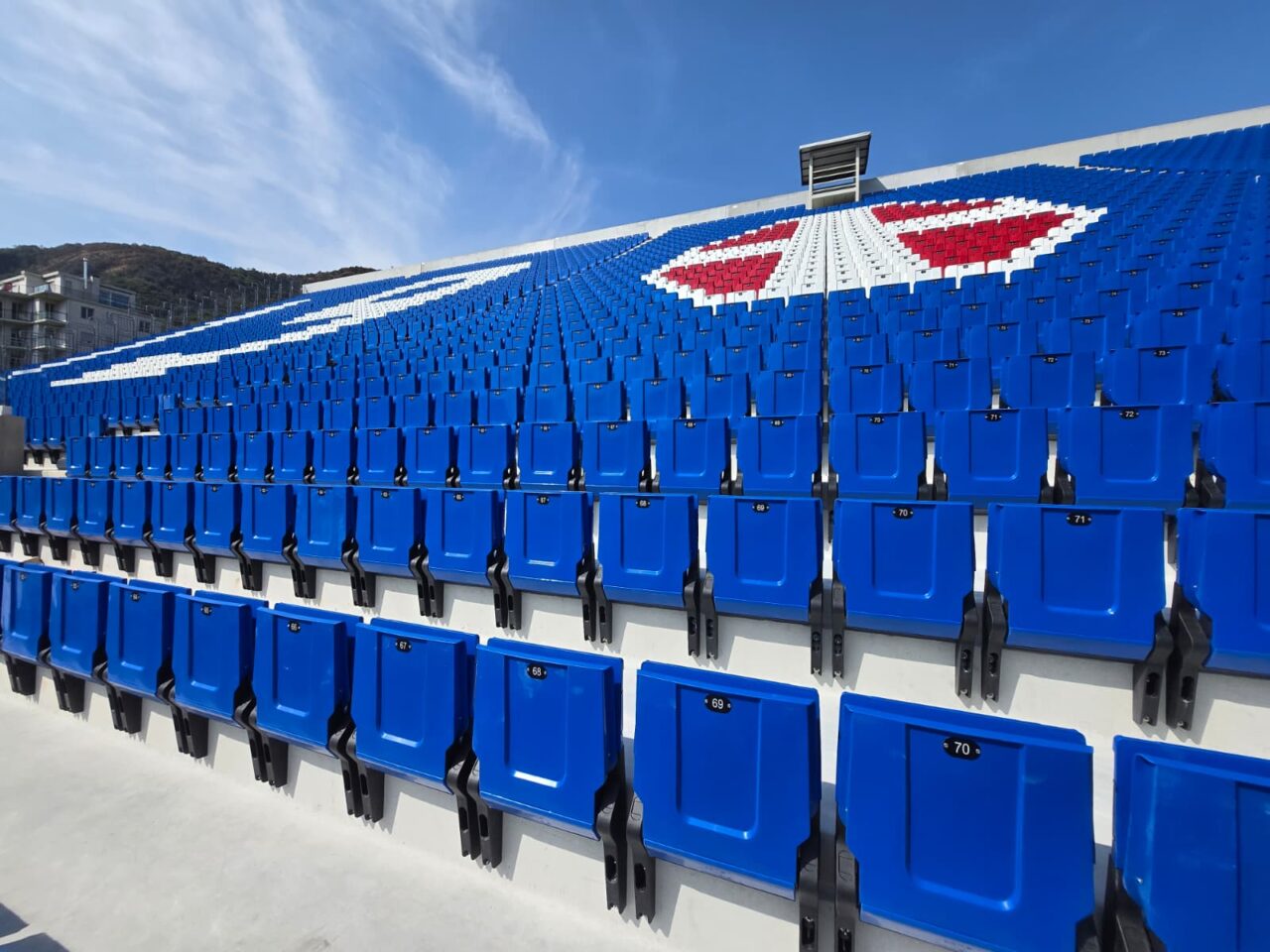
Modern production technologies allow for extensive customization: two-tone seats with embossed logos, patterns that create images or messages visible only from above (like the graphic traditions of Japanese stadiums), integration of the stadium name or sponsor into the seat structure itself, row and seat numbers in a font coordinated with the club's brand.
5.2 Naming rights and sponsorship opportunities
Seat customization also opens up an interesting avenue for sponsorship. Some organizations are exploring models where specific sponsors brand individual sections of the stadium—not just with signage, but with seats in dedicated colors and designs. This type of physical integration with the venue has a much higher perceived value than simple perimeter advertising.
The return for the sponsor is measurable: branded sessions are present in every photo, every TV shot, and every viewer-generated piece of content on social media. They can't be skipped, they can't be blocked by ad blockers, and they don't expire after thirty seconds. They are present for the entire duration of the event and, to the extent that the sessions last 10-15 years, for the entire useful life of the investment.
5.3 Personalization as a differentiating service of OMSI
OMSI offers its clients a structured customization process that begins with an analysis of the club or facility's brand identity and culminates in the production of custom seating with specific RAL colors, integrated logos, textures, and select materials. The in-house design team works closely with the client's communications department to ensure the final result is consistent with the visual identity manual and the facility's functional needs.
6. Case study: stadiums that rewrote the rules
6.1 Tottenham Hotspur Stadium – London
Opened in 2019 after an investment of over £1 billion, the Tottenham Hotspur Stadium is now considered the world benchmark for multi-purpose stadium design. With a capacity of 62,850 and a design entirely geared towards the fan experience, it represents an exemplary case study for anyone who wants to understand where the industry is headed.
Seating design has been central to the strategy from the outset. All seats offer optimal visibility of the pitch thanks to a precisely calculated rake (inclination of the stands). The premium sections—representing approximately 22% of the capacity—include reclining seats with footrests, integrated USB connectivity, and on-site F&B service. The hospitality area boasts 60 private lounges and generates an estimated annual hospitality revenue of over £80 million for Spurs, equivalent to approximately 35% of total matchday revenue.
The result? An average occupancy rate of over 99% in the post-opening seasons and a season ticket waiting list exceeding 100,000 people. A product quality indicator that's hard to dispute.
6.2 Allianz Arena – Munich
The Allianz Arena is one of the first European stadiums to systematically implement the concept of experience segmentation. With over 70,000 seats and six distinct seating categories, it has built a diversified revenue model over the years that makes it virtually immune to fluctuations in sporting results.
Bayern Munich generates approximately 20% of the club's total revenue from matchdays—a high percentage by European standards, only possible thanks to a facility designed to maximize every square meter. The seats in the Business and Lounge stands were completely renovated in 2022 with next-generation products: memory foam padding, heated backrests for the winter months, and a completely silent tilting system.
6.3 Santiago Bernabéu – Madrid (renovation 2023)
The renovation of the Santiago Bernabéu, completed in 2023, is the most recent and radical example of transforming a historic stadium into a next-generation venue. The overall investment exceeded €900 million, with a significant portion dedicated to redefining the spectator experience.
The seats have been completely replaced with state-of-the-art products, with an average width increased by 12% compared to the previous configuration. The premium areas have been completely revamped, with the introduction of private boxes directly overlooking the pitch with access from the stands—a solution that has allowed Real Madrid to more than triple hospitality revenue compared to the season prior to the renovation.
But the Bernabéu has also introduced forward-looking innovations: seats integrated with interactive screens in the hospitality areas, an LED lighting system in the stands synchronized with events on the pitch, and the possibility of transforming the facility into a venue for concerts and corporate events with a completely different seating configuration.
In terms of seating, the stadium was designed from the outset with a five-tier layout: from the stands to the private boxes, through the lateral stands and the Club sections. The number of hospitality seats—approximately 4,000 out of a total of 41,507—generates a disproportionate share of revenue compared to its impact on capacity. In pre-pandemic seasons, Juventus ranked among the top six European clubs in matchday revenue, an extraordinary achievement considering it operates in one of the football markets with the lowest average ticket prices.
7. Considerations for investors and plant operators
7.1 Calculating the ROI on sessions
One of the obstacles to investing in higher-quality seating is the difficulty in rigorously quantifying the return on investment. Seating doesn't generate direct revenue: its benefits are indirect, diffuse, and often perceived as soft. How do you build a convincing business case for replacing or upgrading 10,000 seats?
The most reliable model starts from four economic impact items: (1) increase in average expenditure per spectator, quantifiable with sector benchmarking data; (2) increase in the rate of season ticket renewals, valued at the lifetime value of the fan; (3) increase in the average ticket price in renovated sections, generally by 15-35%; (4) reduction in maintenance and replacement costs in the medium term, thanks to more durable products.
Applying these four factors to a medium-capacity European stadium (45,000 seats), with a full seat replacement investment of around €3-5 million, financial models typically show a payback period of 4-7 years and an IRR above 15% over a 10-year horizon. These figures make the investment competitive with other capital allocation options in the sector.
7.2 Regulations as investment drivers
An often overlooked factor is the role of UEFA and FIFA regulations in accelerating investment in seating. The approval requirements for participation in European competitions include minimum standards for seating types (seated only in most competitions, progressive elimination of standing room), installation safety, and specifications for width and visibility.
For many clubs aspiring to enter or remain in European competitions, regulatory compliance for training sessions isn't an option: it's a necessity. The smart choice—and the one OMSI recommends—is to transform this necessity into an opportunity, designing the intervention not as a minimal adjustment but as a strategic upgrade that maximizes financial and brand benefits.
7.3 Sustainability and lifecycle management
A growing topic on the agenda of venue managers is the sustainability of facilities. Sports seating, made from plastic materials and synthetic fabrics, has a significant environmental impact—both in production and disposal. The most advanced manufacturers, including OMSI, are investing in lower-impact solutions: recycled or recyclable materials, energy-efficient production processes, and take-back programs for end-of-life seating.
Sustainability isn't just an ethical value: it's increasingly a commercial driver. Major European clubs, institutional partners (UEFA, FIFA, national federations), and ESG-oriented investors are considering the sustainability of their facilities as a key evaluation criterion. A facility with seats certified for recycled content and an end-of-life recycling program can access financing and partnership opportunities that would otherwise be closed to them.
8. Emerging trends: where the sector is going
8.1 Technology integrated into the seats
The line between seating and technological device is blurring. Next-generation seating for premium and hospitality areas already integrates features that seemed like science fiction just five years ago: wireless charging for smartphones and tablets, connection to personalized information displays, occupancy sensors for real-time capacity management, and haptic vibration systems synchronized with key event moments.
The next step—already in the prototyping phase at some leading manufacturers—is the integration of flexible OLED screens into the headrest or seat backrest, capable of displaying statistics, instant replays, service information, and branded content in real time. The commercial potential is enormous: every premium seat becomes a direct communication channel with the viewer.
8.2 Artificial intelligence in experience management
AI is entering the management of sports facilities through multiple vectors: dynamic ticket price optimization, personalization of F&B offerings based on spectator past behavior, forecasting internal traffic flows to reduce queues, and real-time sentiment analysis using social media data.
In this scenario, the data generated by smart seating (occupancy, detected body temperature, interactions with integrated displays) becomes valuable input for experience management systems. The result is a virtuous cycle: the more data collected, the more precise the personalization, the higher the level of spectator satisfaction and—consequently—their spending and loyalty rate.
8.3 The mobility of the seats and the modular stages
A recent trend, accelerated by post-pandemic economic hardship, is modular stadiums and flexible configurations. Venues designed to host multiple sporting events—football, rugby, athletics, concerts—require seating that can be easily removed, repositioned, or replaced. This has prompted manufacturers to develop reversible installation systems and quick-assembly/disassembly seating.
OMSI has responded to this trend with modular seating solutions certified for various competitive formats, capable of adapting to variable configurations without compromising safety or comfort. This represents a significant competitive advantage for facilities seeking to maximize usage days throughout the year.
Conclusions: the session as a strategic investment
This article has covered a vast territory—from the historical evolution of stadiums to the economic impact of seating, from the segmentation of the experience to international case studies—with a single common thread: sports seating is not a technical detail, but a strategic lever with measurable impacts on revenue, brand equity, and loyalty.
For sports clubs, investing in seating means investing in the fan experience, which is the primary source of any sustainable long-term competitive advantage. For facility managers, it means maximizing the return on every square meter of an asset often worth hundreds of millions of euros. For investors, it means understanding that seating quality is one of the most reliable metrics for assessing the maturity and commercial competitiveness of a sports facility.
OMSI brings over 65 years of experience in the design and production of seating for sports facilities of all sizes and types to this sector. We don't just supply a product: we offer a technical and strategic partnership that begins with analyzing the client's specific needs and extends to post-installation support, offering customized solutions for every budget, design, and performance requirement.
"The future of stadiums is being built today, one session at a time. OMSI is the partner to build it with."
|
WHY CHOOSE OMSI |
|
• Over 65 years of experience in the production of seats for sports facilities |
|
• Products compliant with UEFA CAF, FIFA 2030 recommendations, FIBA approved and compliant with national and European regulations |
|
• Complete customization: colors, logos, materials and tailor-made designs |
|
• Solutions for every segment: standard, premium, business club and hospitality |
|
• Lifecycle management and certified sustainability programs |
|
• Technical support from design to installation and after-sales |
|
• International portfolio: stadiums in Europe, Middle East, Asia and Latin America |
Want to know how we can transform your system?
Contact us Visit omsi.it for a personalized, no-obligation consultation.