
How to Enhance a Sports Facility by Renovating its Seats
Design and Sports Facilities
A comprehensive guide for managers, designers, and administrators: from diagnosing the current condition to choosing the right seating, all the way to realizing the benefits for the public and the facility's value.
A sports facility isn't simply a venue for events. It's a living infrastructure, capable of communicating identity, professionalism, and attention to the public. Yet, among the elements that make up a stadium or arena, seating is often among the most overlooked—and yet among the most crucial to the overall spectator experience.
Renovating seating today is one of the most effective investments a sports club, municipality, or facility operator can make: not only does it improve comfort and safety, but it also directly impacts brand perception, the ability to attract sponsors, and increases ticket revenue. In this guide, we'll explore why and how to approach this process, with a methodical and results-oriented approach.
1. The state of the Italian grandstands: a heritage to be renewed
The average age of Italian sports facilities is considerable. Many Serie A, B, and C stadiums—not to mention smaller venues—were built or renovated between the 1980s and 1990s, often for the 1990 World Cup. More than thirty years later, the seating installed during that period shows obvious signs of aging: discoloration, cracks, worn surfaces, and deteriorated fastening mechanisms.
But the problem isn't just aesthetic. Safety regulations have evolved, UEFA and FIFA standards for stadium approval have become more stringent, and audiences' awareness of the quality of their experience has grown exponentially. Meeting international standards today means having renovated, comfortable, visually consistent, and technologically up-to-date stands.
In this context, renewing the seats isn't optional: it's a strategic necessity. And like any strategic investment, it must be carefully planned, starting with a clear diagnosis of the current situation.
2. Diagnose the current state: the starting point
Before proceeding with any intervention, it is essential to conduct a thorough analysis of the existing conditions. This often overlooked phase actually determines the quality of the entire subsequent process.
Technical inspection of existing seats
A specialized technician should systematically check each section of the grandstand, noting: the percentage of damaged or missing seats, the condition of the fastening mechanisms and anchor plates, the compliance of the materials with current fire regulations (Ministry of the Interior Decree), the presence of discolored or chromatically inconsistent parts, and the possible presence of asbestos in older components.
Regulatory and approval verification
National and international sports federations impose specific seating requirements. For the Italian Serie A, the FIGC requires individual seats with backrests for all spectators. UEFA and FIFA, for European and world competitions, add requirements regarding minimum width (generally 45-50 cm per seat), certified structural strength, and the absence of visual obstructions. Non-compliance can prevent the facility from being approved or limit its official capacity, with direct impacts on revenue.
Analysis of the spectator experience
The qualitative dimension must not be forgotten: gathering spectator feedback through surveys, analyzing online reviews, and comparing it with other venues allows us to identify the main points of friction in the grandstand experience. Critical issues often arise related to lumbar comfort, visibility between rows, and the width of seats in VIP areas.
3. Types of seating: choosing the right solution for each context
There's no one-size-fits-all seat. The choice depends on the type of facility, its capacity, its competitive category, its target audience, and the available budget. Understanding the main product categories helps guide your decision.
Monocoque hard shell seats
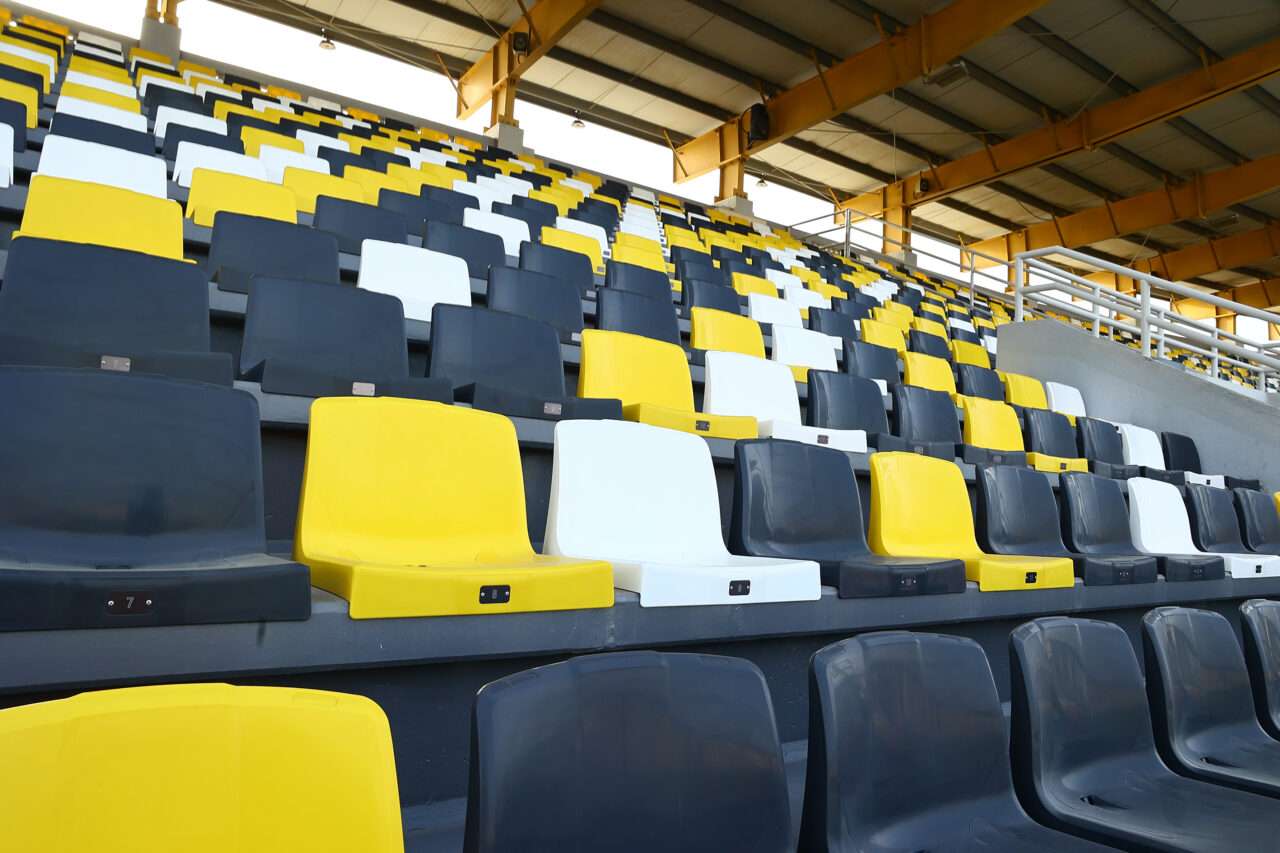
Made of high-strength polypropylene, they are the most popular solution for medium and large capacity stands. The monocoque shell ensures structural strength, easy cleaning, and weather resistance. Thanks to the possibility of producing them in any RAL color, they are ideal for creating customized color patterns on the stands—an increasingly used element to strengthen the club's visual identity.
Seats with padding
Designed for premium areas—central stands, VIP boxes, and hospitality—padded seats elevate the perceived quality of the venue and justify higher ticket prices. They combine a steel or aluminum frame with a padded seat and backrest, upholstered in technical fabric treated to resist humidity and intensive use. Some versions include armrests, a built-in cup holder, and a seat number display.
Telescopic and retractable seats
Particularly suited to multipurpose arenas—designed to host both sporting events and concerts and conferences—telescopic seating offers maximum flexibility of use. When not in use, it collapses, freeing up space for different setups. While requiring a higher initial investment, in the long run, it optimizes the versatility of the facility and maximizes the number of events that can be hosted.
Seats with automatic folding seat
The automatic folding mechanism—which returns the seat to an upright position as soon as the spectator stands up—has become a recommended standard in UEFA approvals. In addition to meeting regulatory requirements, it improves evacuation flows and facilitates passage between rows, thanks to a direct attachment to the front of the stand, contributing to the overall safety of the facility.
4. Chromatic design: seating as a visual communication tool
Of all the decisions related to seating renovation, the color scheme is perhaps the most strategic from a communications perspective. Stadium stands are visible on television, social media, and in press photos: every image circulating represents a brand-building opportunity or, conversely, an element of dissonance if the facility appears dated and disjointed.
Color patterns and club identity
The color scheme of the seats goes far beyond simply choosing a color. More specialized manufacturers, such as OMSI, offer the possibility of creating actual graphic patterns on the stands, reproducing logos, crests, writing, or complex geometric patterns by arranging seats of different colors. This type of solution is visually very effective in overhead shots—typical of sports commentary—and helps make the facility immediately recognizable.
An alternative, increasingly popular approach involves the use of color gradients or shades that follow the natural curves of the stands, creating a dynamic and contemporary visual effect. These solutions require precise planning right from the design stage, with dedicated software simulating the final look before production.
The full stadium effect: seats that simulate the presence of the public
One of the most interesting color schemes of recent years involves the random or pseudo-random distribution of seats in different shades, with the aim of visually simulating the presence of spectators even on days with low attendance. Adopted by some of Europe's largest stadiums, this technique helps avoid the negative visual impact of semi-empty stands, which on television can convey an image of decline for the club and discourage potential new fans.
5. Security and regulatory compliance: an essential pillar
The issue of safety in sports facilities has undergone profound regulatory evolution following the tragedies that have marked the history of European football—from Heysel to Hillsborough. In Italy, the Ministerial Decree of August 8, 1996, and subsequent amendments, along with FIFA and UEFA guidelines, define a comprehensive regulatory framework that all sessions must fully comply with.
Structural strength and load testing
Stadium seating must pass certified strength tests, which simulate the stresses resulting from intensive use and crowd behavior. Specifically, they must withstand horizontal (typical of moments of collective euphoria) and vertical forces, and guarantee structural stability for their entire expected service life, generally no less than 10-15 years. Qualified manufacturers certify their products according to EN 13200 standards.
Fire and vandalism resistance
The materials used for seating must comply with certified fire reaction classifications, generally at least Class 1 according to Italian legislation or as specified by each country.
Resistance to vandalism—scratches, graffiti, and attempted disassembly—is equally important: the high-quality polymers used in professional seating incorporate specific additives that increase surface hardness and limit damage from improper use.
Accessibility and inclusion
Current legislation requires a minimum number of seats to be designated for people with mobility disabilities, located in areas free of architectural barriers and with adequate visibility of the pitch. The seating renovation is the ideal opportunity to review the distribution of these seats throughout the facility, expand their availability, and improve their features, including, for example, adjacent seats for companions.
6. The renovation process: phases, times and management of the construction site
Renovating the seating in an active facility—one that continues to host events during construction—requires meticulous planning. The primary challenge is to minimize the impact on the facility's operations, avoiding prolonged interruptions to the sports season.
Phase 1 – Design and supply
The design process begins with a precise mapping of the facility: the exact number of seats per sector, the geometry of the stands, the distance between rows, the type of flooring, and the load-bearing structure. This data, combined with regulatory requirements and the client's aesthetic choices, allows us to define the executive design and begin production of the seats. Production times vary depending on the quantity and customization required: for large orders, planning is required 3-6 months in advance.
Phase 2 – Removal of existing seats
Removing old seating is an operation that must be handled carefully, both from a logistical standpoint—dismantling, collection, and disposal of materials—and from an environmental perspective. Plastic materials must be sorted and recycled; some manufacturers, including OMSI, offer integrated collection and recycling services for old materials, reducing disposal costs for customers.
Omsi ha recentemente rinnovato con questa modalità lo Stadio ROI BAUDOUIN from Brussels in Belgium which has become a symbol of recycling and eco-sustainability
Phase 3 – Installation
Installation requires specialized teams, adequate equipment, and a work plan that takes into account the areas that must be kept accessible during the work. In large facilities, it's common to divide the work into sectors, completing one block at a time to maintain some of the available capacity. Adhering to the agreed-upon deadlines is critical: a delay that overlaps with a race date can significantly impact the organization of the event.
Phase 4 – Testing and approval
Once installation is complete, technical testing and compliance with applicable regulations must be performed. In many cases, the Municipality or Prefecture must issue its approval before the facility can reopen to the public. Relying on a reputable and experienced supplier who is well-versed in the bureaucratic process and can assist in preparing the technical documentation is a real advantage.
7. The concrete benefits: ROI, sponsorship and value of the system
Renovating your seats generates a return on investment that goes far beyond mere aesthetic improvements. Let's analyze the main value drivers.
Increase in approved capacity
In many older venues, the officially certified capacity is lower than the actual number of seats due to non-compliant or missing seats. Complete renovations allow for the recovery of inactive seats and, in some cases, an increase in the venue's total capacity—with a direct and measurable impact on ticket revenue for each event.
Greater appeal for sponsors
A renovated and visually refined facility is much more attractive to potential sponsors. Naming rights areas, padded seats in premium areas, and the option to integrate customized elements (logoed armrests, seats in corporate colors) are all tools that clubs can monetize through commercial partnerships. In some cases, a grandstand sponsorship contract can fully finance the renovation costs.
Improving the spectator experience and loyalty
Physical comfort is one of the primary factors influencing spectator satisfaction and their propensity to return to the stadium. A comfortable, well-visible, and aesthetically pleasing seat contributes to an overall positive experience, which is reflected in word-of-mouth, online reviews, and season ticket sales. Fan loyalty is a long-term economic asset for any club.
Real estate valorization of the plant
Over the medium to long term, a well-maintained and updated facility increases its asset value. This is particularly important for municipalities and public institutions that manage municipal sports facilities, as the value of public assets impacts their budgets and their ability to access European and national funding dedicated to sports infrastructure.
8. Sustainability and circularity: the future of stadium seating
The transition to a circular economy is also transforming the sports facility supply sector. Designing seating with its entire lifespan in mind—from production to disposal—is no longer optional, but a necessity dictated by both market sensitivities and European environmental regulations.
The most advanced manufacturers, like OMSI, are investing in research into recycled and recyclable materials, developing low-energy production processes, and building recycling chains for end-of-life products. Some chairs are now made from 89% recycled polypropylene, without compromising the product's mechanical or aesthetic performance.
For clubs and venues developing sustainability reports or seeking to comply with the ESG (Environmental, Social, Governance) criteria increasingly required by investors and sponsors, choosing sustainable furnishings in the stands is a concrete and communicable contribution.
9. Choosing the right partner: what to look for in a seating manufacturer
Not all stadium seating manufacturers offer the same level of product, service, and support. Choosing the right partner is crucial to the success of your project. Here are the key criteria to consider.
- Experience and references: How many systems has the manufacturer equipped? At what level? The ability to demonstrate a solid portfolio of installations in comparable systems—by size, type, and competitive category—is a key indicator of reliability.
- Product certifications: seating must be certified according to applicable standards (EN 13200, fire tests, mechanical resistance). A reputable manufacturer has all the technical documentation and makes it available for testing and approval.
- Production capacity and deadlines: Producing thousands of chairs requires a suitable industrial structure. It's important to verify that the manufacturer can meet agreed-upon delivery times, even for large orders.
- Design support: the best manufacturers don't just supply the product, they also support the customer through color design, construction site planning, regulatory compliance, and final testing. This integrated approach reduces risks and improves the overall result.
- Warranty and after-sales support: An adequate warranty (typically 5-10 years for structural components) and the long-term availability of spare parts are aspects often overlooked during the tender phase, but are critical for the operational management of the plant over time.
10. Examples and inspirations: how large facilities have transformed their stands
Looking at what has been achieved in major international and national facilities offers valuable insights for those planning a renovation. It's not about copying other people's solutions, but rather understanding how certain choices have produced tangible results in terms of image, public engagement, and commercial value.
Many European stadiums have opted for multicolored stands featuring the club's logo as seen from above, a choice that has transformed every television shot into a brand communication opportunity. Others have opted for completely differentiated seating areas, with clearly distinct economy, business, and premium seating areas, each with a specific value proposition.
In Italy, several Serie A stadiums have undertaken partial or complete stand renovations in recent years, often in conjunction with participation in UEFA and FIFA competitions that impose specific standards. These interventions have invariably generated a positive response from fans and the media, resulting in an enhanced image of the club.
Conclusions: investing in sessions means investing in the future of the system
Renovating seating is much more than a routine maintenance project. It's a strategic choice that addresses multiple aspects of a sports facility's value: safety, regulatory compliance, spectator comfort, visual identity, sponsor attractiveness, and environmental sustainability.
For facility managers, athletic directors, and public officials, the question isn't whether to renovate seating, but when and how to do it most effectively. The answer requires a thorough assessment of the current state, careful planning that balances aesthetics, regulations, and functionality, and the selection of a manufacturing partner capable of overseeing the entire process with expertise and reliability.
At OMSI, we've been designing and manufacturing stadium seating for decades, equipping venues of all sizes in Italy and around the world. Our experience has taught us that every project is unique—and that the true value of a seat isn't measured only upon delivery, but over time: in its ability to endure, to maintain its shape, to continue expressing the identity of a club and a venue with every match, season after season.
Are you considering renovating the stands at your facility? Contact us for personalized technical advice and find out how we can support you at every stage of the project.
Tags: stadium seating, sports facility renovation, stadium seating, polypropylene, UEFA, FIGC, grandstand comfort, grandstand design, OMSI